Freeze and Thaw Damage: What Winter Does to Your Roof
Prescott's daily freeze-thaw cycle cracks shingles, tiles, and flashing all winter. Here's how it works, the signs to catch early, and what repairs cost in 2026.
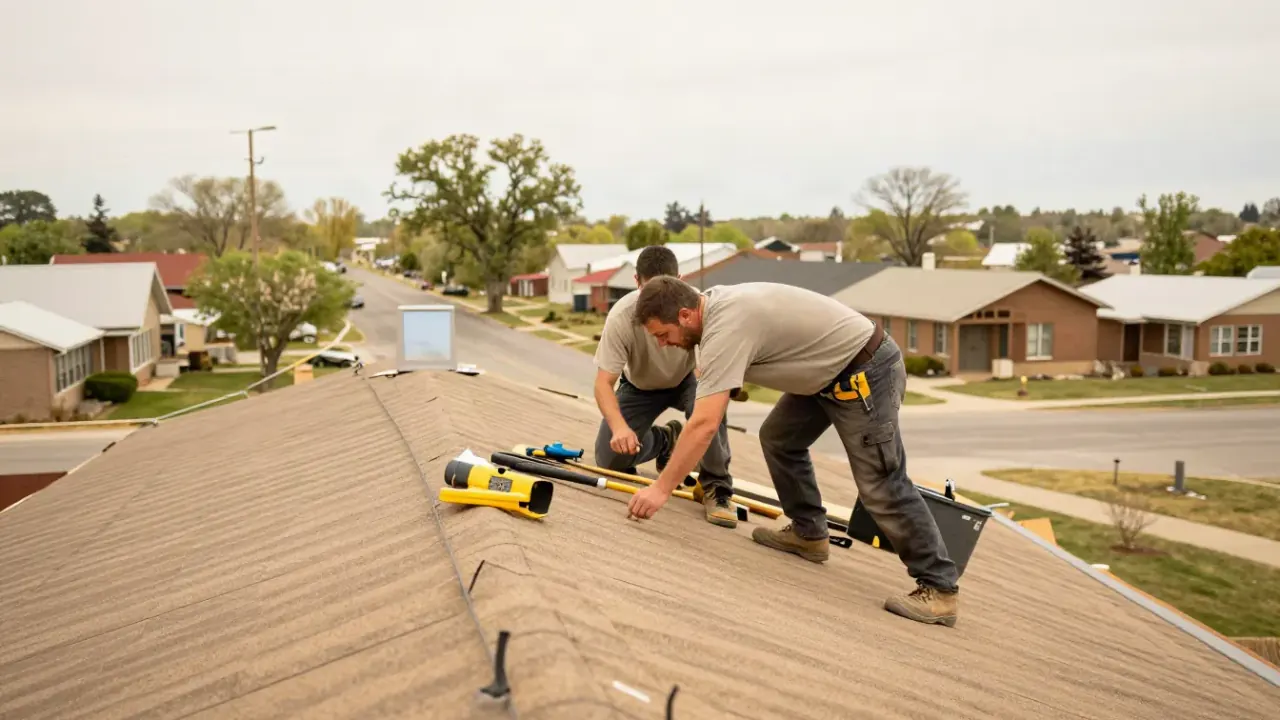
Freeze thaw roof damage in Prescott AZ happens because water seeps into tiny cracks, gaps, and worn sealant during the day, then freezes overnight and expands with enough force to pry shingles apart, crack tile, and open flashing seams. Prescott swings above and below 32°F dozens of times between November and March, so your roof can go through that expand-contract cycle 60 to 90 times in a single winter. This post breaks down exactly how that cycle attacks each roof material, the warning signs to catch before spring, what repairs cost in 2026, and the steps that actually stop the damage from repeating next year.
How Freeze Thaw Roof Damage Happens in Prescott, Arizona
Freeze thaw roof damage is a form of water-driven deterioration that occurs when meltwater penetrates a roof assembly, refreezes, and expands by roughly 9 percent in volume, forcing apart whatever material surrounds it. That 9 percent figure is the whole story. Water is one of the few substances that expands when it freezes, and it does so with enough pressure to split rock, which is why you see cracked boulders all over the Granite Dells.
The cycle repeats in three stages, and it runs almost every day from late fall through early spring here.
- Daytime melt. Prescott afternoons in December and January regularly climb into the 40s and low 50s. Snow and frost on the roof melt, and that water finds every gap: lifted shingle tabs, cracked tile, dried caulk around a vent boot, a loose chimney counter-flashing.
- Overnight freeze. Prescott lows drop into the teens and 20s most winter nights. Trapped water freezes and expands, widening the gap it entered through.
- Repeat. The next afternoon, more water gets in. The gap is bigger. By February, a hairline crack in a tile or a pinhole in flashing is a channel that reaches your decking.
This is why winter roof damage in Prescott rarely shows up as one dramatic failure. It shows up as a stain on a ceiling in March that nobody can trace back to a single storm.
Why Prescott's Climate Is Hard on Roofs
Prescott sits at about 5,400 feet, and that elevation is what drives the freeze-thaw problem. We get roughly 12 to 17 inches of snow in a typical winter, but the snow is not the main issue. The issue is that it does not stay frozen.
Compare us to a city like Flagstaff, where winter stays cold enough that snow sits on roofs for weeks. Here, a 6-inch snowfall on a Tuesday is often gone by Thursday afternoon, and every one of those melt-and-refreeze cycles works on your roof. A roof in Phoenix might see three or four freeze events a year. A roof in Prescott sees 60 to 90.
Add our summer UV load, which bakes sealants and dries out shingle mat, and you get a roof that is already slightly compromised by October. Winter then finds every weak point. That combination is why we tell homeowners that fall is the single most valuable time to have someone look at the roof, and why we handle Roof Inspections Prescott AZ before the first hard freeze rather than after the first leak.
Wind matters too. Prescott's winter storms often arrive with 30 to 45 mph gusts, which lift shingle tabs and push water sideways under them. Once a tab is lifted, freeze-thaw keeps it lifted.
What Are the Signs of Winter Roof Damage in Prescott?
The signs of winter roof damage in Prescott show up in a predictable order, and catching them at the first stage is the difference between a $400 repair and a $9,000 deck replacement. Check your roof from the ground with binoculars after any snow event, and check your ceilings after any hard freeze.
Exterior signs
- Shingle tabs that stay lifted after the snow melts. If a tab does not lay flat by the next warm afternoon, the seal strip is broken.
- Granules in the gutters or at the downspout splash blocks. A handful after a storm is normal. A steady accumulation means the shingle surface is failing.
- Cracked or slipped tile. Look for diagonal cracks and tiles that have slid out of line, especially on south-facing slopes where melt happens fastest.
- Rust streaks or white mineral staining on flashing. Both point to water sitting in a seam that should be dry.
- Ice dams along the eaves. A ridge of ice at the roof edge means meltwater is backing up under the courses above it.
Interior signs
- Brown or yellow rings on ceiling drywall, especially near chimneys, skylights, and exterior walls.
- Paint that bubbles or peels in a straight line, which usually traces a roof seam.
- A musty smell in an attic that was dry in September.
- Daylight visible through the roof deck boards from inside the attic.
If you find any of these, do not wait for spring. Water that is inside your roof assembly in January is still there in April, and it is feeding rot the whole time.
Which Roof Materials Take the Worst Hit
Every roof material in Prescott takes freeze-thaw damage differently, and knowing which one you have tells you what to watch for. We work on all four of the common roof types here, and the failure patterns are consistent.
Asphalt shingles
Shingles fail at the seal strip first. The adhesive that bonds each tab to the one below gets brittle after a few summers of UV, and once it lets go, wind and freeze-thaw finish the job. Lifted tabs let water straight to the underlayment. If your shingles are more than 15 years old and you are seeing tabs stay up, it is time for Shingle Roof Repair Prescott AZ before the next storm season.
Clay and concrete tile
Tile itself is tough, but the mortar and underlayment beneath it are not. Water gets under a cracked or slipped tile, freezes, and pushes the next tile out of line. On 20-year-old tile roofs, the underlayment is usually the real problem, not the tile. That is a job for Tile Roof Repair Prescott AZ, and it is far cheaper than a full tear-off if we catch it early.
Metal
Standing-seam and corrugated metal roofs handle freeze-thaw better than anything else, but the fasteners and the sealant washers around them are the weak point. A backed-out screw leaves a hole that water enters and ice widens. We see this most on roofs over 12 years old.
Flat and low-slope
Flat roofs are the worst case for freeze-thaw because water does not drain off them quickly. Ponding water at a low spot freezes, expands, and lifts the membrane. If you have a flat roof over a garage, porch, or addition, that is where we find the most damage every spring.
How to Prevent Freeze Thaw Roof Damage in Arizona
Preventing freeze thaw roof damage in Arizona comes down to one principle: keep water out of the roof assembly before the first freeze. Everything below is something you can do or schedule between now and November.
- Clear the roof and gutters before the first snow. Pine needles and oak leaves hold moisture against the roof surface and block drainage. A clogged gutter in December is an ice dam in January.
- Seal penetrations in the fall. Vent boots, pipe collars, and chimney counter-flashing are where 80 percent of our winter leak calls start. Fresh sealant applied in October lasts through the season. Sealant applied in February does not cure properly.
- Fix lifted shingle tabs now, not in spring. A tube of roofing cement and 20 minutes on a warm afternoon can save a deck panel.
- Keep the attic cold. Insulation and ventilation work together. If your attic is warm, snow melts from underneath, refreezes at the eaves, and builds an ice dam. We check attic ventilation on every inspection for exactly this reason.
- Trim overhanging branches. Branches that hold snow against the roof keep that section wet and shaded, which slows melt and prolongs the cycle.
- Do not chip ice off the roof. You will damage shingles, tile, and flashing. Let it melt or call us.
If your roof is older or you have already had one leak, a preventive treatment makes sense. We apply Roof Coating and Sealing Prescott AZ on flat roofs and metal roofs to close the small gaps that freeze-thaw exploits, and it typically buys several seasons before a bigger repair is needed.
Common Mistakes We See Every Winter
The same handful of mistakes show up on Prescott roofs every single winter, and most of them make the damage worse rather than better. Here is what to avoid.
- Waiting until spring to call. A leak found in January is usually a $300 to $800 repair. The same leak found in April, after four months of freeze-thaw, is often a $3,000 to $9,000 repair because the decking and insulation are wet.
- Climbing the roof in icy conditions. We have seen more homeowner injuries than roof failures. Stay on the ground and use binoculars.
- Patching over wet material. Sealant and patch tape will not bond to a wet surface. It looks fixed for a week and then fails at the next freeze.
- Assuming a ceiling stain is condensation. Sometimes it is, but in Prescott in winter, it is usually a roof leak. Get it looked at either way.
- Ignoring a small interior stain because it stopped growing. It stopped because the water found a new path. It is still in there.
- Letting a contractor talk you into a full replacement when a repair will do. On a 12-year-old shingle roof with two lifted tabs, you need a repair, not a new roof.
One more: do not assume that because your roof is only eight years old it is fine. We see freeze-thaw damage on newer roofs all the time, usually at flashing and penetrations where installation details matter more than shingle age.
When to Call a Professional
Call a professional when you see water inside the house, when a shingle tab stays lifted after a warm afternoon, when tile has cracked or slipped, or when you find ice damming at the eaves. Those are the four conditions where a small repair this month prevents a major one in spring.
At Prescott Roof Repair, we handle freeze-thaw damage across every roof type and every neighborhood in the area. We find the entry point, fix it, and test it with water before we leave, and we tell you upfront what the repair costs before we start. If you are in one of the older neighborhoods with mature pines and heavy shade, like Roof Repair in Hassayampa Village, we know the specific patterns those roofs develop. Same story out toward the lake, where wind-driven snow hits west-facing slopes harder, which is why we do a lot of Roof Repair near Willow Lake in January and February.
We also handle the related damage that comes with winter storms. If a storm took off shingles or drove hail into your roof, that is a different repair path, and we cover it under Storm and Hail Damage Repair Prescott AZ.
Frequently Asked Questions
How does freeze and thaw damage a roof in Prescott AZ?
Meltwater enters small gaps in shingles, tile, or flashing during the day, then freezes overnight and expands about 9 percent, widening the gap. Prescott sees 60 to 90 of these cycles each winter, so damage compounds fast. The result is cracked tile, lifted shingles, opened flashing seams, and eventually interior leaks.
What are signs of winter roof damage in Prescott?
Watch for shingle tabs that stay lifted after a warm afternoon, granules collecting in gutters, cracked or slipped tile, rust streaks on flashing, and ice dams at the eaves. Inside, look for ceiling stains near chimneys and skylights, bubbling paint, and a musty attic smell. Any of these means water is already inside the assembly.
Can freeze thaw roof damage be repaired in Prescott?
Yes, and almost all of it is repairable if we catch it before spring. Typical 2026 repairs run $300 to $900 for flashing, sealant, or a few shingles, and $1,200 to $3,500 for larger tile or underlayment work. Once decking and insulation are saturated, costs climb into the $3,000 to $9,000 range.
How to prevent freeze thaw roof damage in Arizona?
Clear gutters and roof debris by early November, reseal vent boots and chimney flashing in the fall while sealant still cures, fix lifted shingle tabs immediately, and keep attic insulation and ventilation balanced so snow does not melt from underneath. A fall inspection catches most problems for under $300.
Does a newer roof still get freeze-thaw damage?
Yes. Shingle age is not the deciding factor. Most freeze-thaw damage we find on roofs under 10 years old is at flashing, vent penetrations, and valleys, where installation details matter more than the shingle itself. A single poorly sealed pipe boot can leak for three winters before you notice a stain.
Get Help with Roof Repair in Prescott
If you have seen a ceiling stain, a lifted shingle, or ice building up at your eaves, get it looked at now rather than in April. Prescott Roof Repair handles freeze-thaw damage, winter leaks, and storm repairs across Prescott and the surrounding communities, and we will tell you plainly whether you need a repair or a replacement.
Call us at (928) 260-9145 to schedule a winter roof inspection or repair. We will find the entry point, fix it, and confirm it is dry before we leave.